PETER LYNCH THIS IS NOT THAT
SANDLER HUDSON GALLERY
Peter Lynch began formulating his idiosyncratic approach to abstraction in the early 1990s under the guidance of artists such as Callum Innes, alongside notable students like Sue and Hayley Tompkins, and Jim Lambie when doing his undergraduate degree at Glasgow School of Art. There, he discovered an abiding interest in the principles of painting, exploring colour and non-colour, and probing the space between tactility and translucency.
He continued his education at Goldsmiths, University of London, taught by the likes of Michael Craig-Martin and Terry Atkinson. He returned to Glasgow as an artist-in-residence in 2000, where he embarked on his interrogation of the painterly object and surface by means of bodily gesture— using rhythmic, sensual 'zips' of the artist’s finger to trace and erase the very structure of the grid itself.
Peter Lynch has exhibited widely in the UK and internationally since the mid-1990s, with solo exhibitions at Transformation Gallery in London, The Bear in London, Window/Finestra in Venice, and Connect Art in San Francisco, among many others. His work has also been included in numerous group exhibitions at venues such as Vane Gallery in Newcastle, Split Level in New York, the Inverleith House at the Royal Botanic Garden Edinburgh, Hunter College in New York, and the Vértice Galería de Arte in Lima. In addition to maintaining an active multimedia studio practice, Lynch has been the studio manager to Anish Kapoor in London since 2010.
Pujan Gandhi is an independent curator who bridges historic and contemporary art with a transnational perspective. From 2018 through 2024, he oversaw the South, Southeast Asian, Himalayan, and Islamic art collections at the Minneapolis Institute of Art. There, he mounted the first reinstallation of its galleries in over 20 years and made significant acquisitions in the realm of Mughal and Pahari paintings, Himalayan art, and Indonesian textiles. Simultaneously, he realized installations by Dayanita Singh, Zarina Hashmi, and Monir Shahroudy Farmanfarmaian.
Having organized a host of international exhibitions, he has published on a range of topics including Isabella Stewart Gardner’s travel albums of India and strategies for 21st-century museum displays, and he edited the multi-author monograph Anish Kapoor: Reverie and Rapture. Previously, he served as the consulting curator in the African Art Department at the High Museum of Art in Atlanta and worked as an art advisor and guest lecturer at SOAS, University of London, where he earned his Postgraduate Diploma and MA in the History of Art and Archaeology while cataloging at the British Museum.
He was raised in Atlanta, Georgia, where he attended The Lovett School, class of 2005, and is a graduate of Middlebury College.
Discussion with Peter Lynch & Pujan Gandhi
Pujan Gandhi
"Thanks so much, Noah. Robin and Debbie, and everyone here—thank you. In addition to what was said, there was also a stint right after college as a very unpaid intern at the High Museum, where I got to work on exhibitions with Radcliffe Bailey. That’s where I started coming out of the 'school of Atlanta' and embracing and learning about the art community here.
I think we’re all here today because we were able to mount this show as a testament to the binding power of art across time and space. Likewise, in our relationship, we’ve thought about creating a compelling context to re-expose your long-abiding painterly and gestural practice.
I want to frame the show by noting we’re looking at two bodies of work. I think the earliest might be from 2021—the paintings and the works on paper. Looking at these works, a question occurred earlier: 'Are they watercolour?' In fact, what you’ll find is that as part of his practice, Peter makes gestures with watercolours. In some ways, he is the classic Zen master—possessing a pure psychic automatism, a control of the brush that exposes the 'loaded brush' and its possibilities.
However, despite how tactile and sensuous the paper is, you eventually realise they are actually digital reproductions—blown-up versions of those initial marks, screened and selected for what you see here. I’m wondering about this issue of gesture: how it is subverted here through mediation. Perhaps we could talk about that and then leap into your paintings to see how they relate.”
In his 1924 Manifest of Surrealism, Breton defined the movement as “Psychic automatism in its pure state, by which one proposes to express...the actual functioning of thought...in the absence of any control exercised by reason, exempt from any aesthetic or moral concern.”
Manifesto of Surrealism by André Breton, 1924

Yugok-Ro-2_Gil VIII, 22.08.23 (2023)
Archive in on paper
47 x 34.5 in
Peter Lynch
"So, shall I start by talking about the watercolours? There was a period of time where I was making paintings on canvas, and at a certain point, I realised I really wanted to try watercolours. I wanted to see if I could make something as meaningful as my work on canvas —not necessarily identical or a representation of the canvas works, but leading somewhere else.
I started messing around and made some terrible works, as you do when you start experimenting, but I eventually decided to really simplify it. I began doing very simple gestures. Initially, it was the rectangle. What I discovered by complete accident is that when you apply paint to the paper, you would expect the watercolour to spread beyond the brush mark— but it doesn't.
Ultimately, you apply a single linear brush mark, and where the brush hits the paper, the pigment stays within that area. So, the control is within the gesture of the mark, but inside that mark,
there is a cacophony of colour and movement. I found that fascinating—this balance of control and non-control.
Then, I decided to blow them up to see what happened to the scale. From my point of view, the enlargement emphasises the journey of the paint within the surface of the mark. They become very different works from the original watercolours. Last year, I made 300 watercolours, and from those, I probably edited it down to 50 that I thought were any good. It’s an editing process within the studio practice. Does that make sense?”

Left: Pink on walls VII, 25.05.25 (2025)
Archive in on paper
28 x 19.6 in
Right: Perfect world II, 12.05.25 (2025) Archive in on paper
28 x 19.6 in
PG
"Yeah. When you look at them or create them, when do you let associations or metaphors come in? Is it a purely formal assumption, or is there an 'aha' moment when something crystallises?”
PL
"Well, it's usually just whether I think it's a good one or a bad one. It’s my own sensibility. If I presented the original watercolours to a lot of people, they might point to one I rejected and say, 'Oh, that’s a great work.' But to me, some don't work because the 'bleed' isn't interesting or the paint gets muddy.
It’s a sensibility that’s difficult to define. The mark itself is a defined thing, but what is happening inside it is something I have no control over. Control versus non-control.”
PG
"If we look at the taxonomy of the work—drawing, painting, watercolour—Franz Kline would say painting is a form of drawing. How would you leap from that to the tactility of your larger works? They are both painterly, but in very different ways.”
“I rather feel that painting is a form of drawing and the painting that I like has a form of drawing to it. I don't see how it could be disassociated from the nature of drawing.... I find in many cases a drawing has been the subject of the painting – that would be a preliminary stage to that particular painting.... the painting can develop something that is not at all related to the drawing and have no particular mood about it at all; it's just a cool kind of reality that has a series of involvements within it; and the pure excitement of those things happening within this form is enough for that particular panting.. “
Franz Kline, Living Art 1963
PL
"With the paintings, when I start, I have no idea what they will turn into. I start with an initial layer that I know will eventually disappear, but I have to do it just to begin. I often work on 10 or 15 paintings at once, rotating them. I’ll mix a batch of paint and sometimes I’ll 'draw' a structure onto the canvas using my finger.
As I work, the paintings go in different directions. The application is quite tight; I use my finger (which removes paint), a paintbrush, and a printing roller. Those three elements are constantly fighting each other. Sometimes the finger mark is prominent; sometimes it's hidden or monochrome. If you look closely, you can see the history of those 20 or 30 layers of paint. I keep going until I feel the painting has been 'born.'
I think the link to the watercolours is that I have no idea what they’ll become. By the 'end game,' I have no recollection of where the painting started—and I don't want that recollection, because I don't want to redo a past work. It’s about the journey of the stroke."
PG
"We talk about process, but it’s also about generative constraints—pushing and pulling within a system. You mentioned chance and improvisation. We’re moving from Franz Kline to something more systemic. We were talking about Sol LeWitt earlier. To what degree do you agree with his idea that if an artist changes his mind midway through execution, he compromises the result?”
“1. Conceptual artists are mystics rather than rationalists. They leap to conclusions that logic cannot reach.
2. Rational judgements repeat rational judgements.
3. Irrational judgements lead to new experience.
4. Formal art is essentially rational.
5. Irrational thoughts should be followed absolutely and logically.
6. If the artist changes his mind midway through the execution of the piece he compromises the result and repeats past results.
7. The artist's will is secondary to the process he initiates from idea to completion. His wilfulness may only be ego.
8. When words such as painting and sculpture are used, they connote a whole tradition and imply a consequent acceptance of this
tradition, thus placing limitations on the artist who would be reluctant to make art, that goes beyond the limitations.
9. The concept and idea are different. The former implies a general direction while the latter is the component. Ideas implement the
concept”
Except from
“Sentences on Conceptual Art”Sol LeWitt, Art and Language, May 1969
PL
"I actually disagree with that! I’m a massive fan of LeWitt, but his work is defined by a conceptual approach where the start determines the end. In my work, the start is not the end. There is a system in place to hold the language, but within that complexity, things grow and create themselves.
I almost see these paintings as children. When they are on the wall, they are born; they have their own identity. I’ve created them, but now they exist in their own right. It’s important to remove the ego—the work is its own expression, not necessarily mine."
PG
"It is a leap to remove the ego. When an audience looks at abstract work, they are often looking for a 'hook'—somewhere to hang their coat. For example, that work on the wall, the silky forest green —what is the title?"
PL
"Good question. It’s called: 'Would Never Be Able To Get Them To Return.’”

would never be able to get them to return (2023) revised (2025)
acrylic on linen
61 x 45.7 x 2 cm
PG
"So, in a way, the painting is talking to itself. The titles feel like a bit of a game. It's pure abstraction, but a title suddenly adds weight."
PL
"Exactly. People want to find a narrative, but often it’s a false narrative. Especially in the UK, people want abstraction to be of something. We are a very linguistic country, so people want a
story to take them on a journey. I don't think that has to happen. A painting can just be about surface and texture.
As for titles, I always found calling something 'Untitled' to be a bit of a cop-out. Maybe 'No Title' is better if you want to avoid interpretation, but 'Untitled' always felt like a strange way of avoiding the issue. To me, it's about the charisma of the work itself—and of course, the colour.
PG
"If one were to attempt to identify a start and an end, we’d be looking at the surface of the work—a dimensional surface throughout, involving space and colour. In that way, the way you arrive at something appears to most as something intuitive, yet uncanny—perhaps even novel. How did that emerge, or where does that fall into the process?"
PL
"Colours are peculiar. When I started making the finger paintings—this was when I was an undergraduate and I did it for my degree show—I made these paintings where I basically used the bottom of the bucket of sludge. I made the paintings from that, and then I decided to try and remove the biggest, 'chunky' bits with my finger. That was the painting. It was very much about aggressively attacking the process of painting, which I think was a bit of a cop-out in some ways.
However, it was an interesting process because it made me realise there was a language I could
pursue. Initially, I did a lot of black and grey paintings. I was interested in the idea of 'killing' colour.
I made an awful lot of grey paintings, but they were made from complementaries. You start with
colour, but you are dissolving it. Of course, with greys, you can always see the hints of what those
original colours were.
When I brought colour back into it, I suspect they were still related to greys. A green is a grey-

since i don't have you, (2022)
acrylic on linen
36 x 28 x 2 cm
green; even when they are bright, they’ve been 'knocked back' or killed a
little bit. That’s always been important to me—it’s an aesthetic thing. I like these colours.
Another thing I find interesting is that everybody sees colour differently anyway. Everyone’s eyes are slightly different. Recently—I can’t name names—but I discovered a curator who is colourblind. I thought that was amazing. How on earth can you work in the visual arts and be colourblind? But he does, and he’s very successful. Interpretation of colour, much like texture, is personal. Some people like blue; some people may prefer the canvas works over the works on paper. I can't control that."
PG
"Are the works expressive? Is colour expressive? Or is it the practice itself that is expressive?"
PL
"If it is, it’s a very controlled expression. It’s not 'expressionistic.' There is a form of gesture, but the physical embodiment of the body within the work is controlled. What’s interesting about the watercolours is that by increasing the scale, the gesture remains very tight—it’s the hand and the arm, not the full body.
When you increase the scale of paintings and gestures, the body usually comes into play. I’ve always avoided that—the physical movement of the body—preferring just the movement of the hand and arm. Part of the finger paintings is the specific scale of the finger. Once the paintings get bigger, if you still have that fine finger mark, it becomes even more apparent. I’m disguising, layering, and playing with those three elements—the brush, the roller, and the finger mark. I feel once the scale grows too much, it becomes difficult to allow that play to happen."

left baffled and mystified (2024)
acrylic on linen
60 x 80 x 3 cm
PG
"When we were installing the show, the work on the left— remind me of the title? Baffled and Mystified?”
PL
"Yes, Baffled and Mystified. It’s a good title.”
PG
"Now that you’ve revealed so much—and thank you for that generosity—you mentioned the tonality of that painting and the act of installing it in the space."
PL
"That is the largest painting in the show in terms of
traditional scale. I’ve thought about making them bigger,
but I often feel they don’t quite work. I’m thinking about potentially removing
the finger mark and making a monochrome, while keeping the relationship
with the smaller paintings.
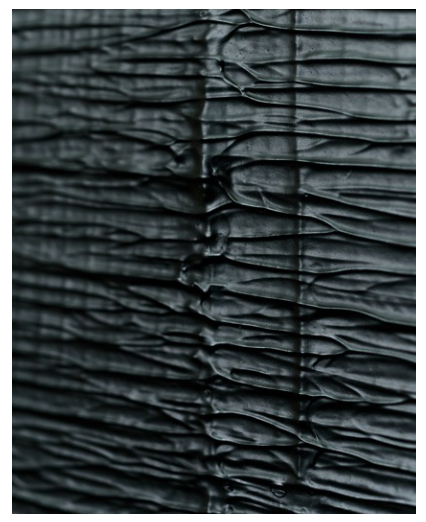
detail: left baffled and mystified (2024)
acrylic on linen
60 x 80 x 3 cm
People look at the work and think, 'Oh, the roller made that effect,' but the end result is simply paint. I think it's interesting that when you see the paintings, you don't necessarily understand how they were made until I explain the process. They are difficult to decipher.
They are also sensitive to lighting; they change as you walk around them. They are slow burners. You might initially think, 'That’s a pure, flat monochrome,' but as you spend time with them, they reveal different things. It reminds me of being at art school and looking at reproductions of Mondrian. In books, they looked very flat—an art history exercise. But when I saw a Mondrian in person, I thought they were exquisite. They are tentative and very human in scale.
Mondrian had a very specific conceptual position, but the paintings themselves were something else entirely. I like the idea that I can look at a Mondrian and ignore his concept just to enjoy the painting. Maybe I’m not supposed to do that, but I do. Art history is ultimately an interpretation— even the artist's own concept is just a linguistic interpretation of something spatial.”
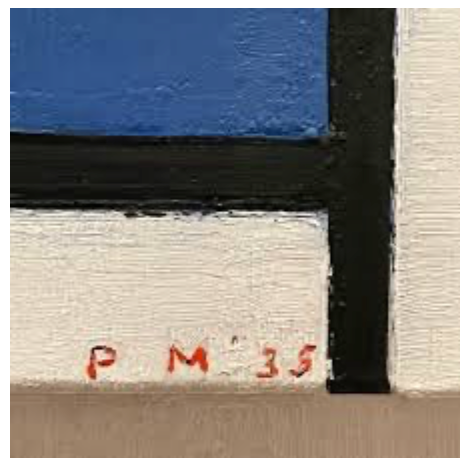
Piet Mondrian (1872 - 1944),
Composition C (No.III) with Red, Yellow and Blue (1935)
Oil paint on canvas
560 × 552 mm
Tate Modern
PG
"And as you said, that duration is the point. Time is the greatest non-fungible commodity. To offer that reminder in a quiet sense is a great achievement. When I visited your studio—which has that lovely skylight—paint is your language, your music. But in this show, the paint becomes spatial. You are a spatial artist as well."
PL
"You’re right. Presenting the artwork is another level of importance. For this particular wall, I wanted a rhythm that allowed relationships between paintings to occur. There are many ways to do that—fewer works, or even a 'salon hang'—and the presentation changes the work again.
That is another generative constraint. With sculpture, you have to deal with the room and the placement. People often neglect that with 2D work, but a painting is still an object. Even though it’s on the wall, it deals with the space and its relationship to the person looking at it. It was important to me to allow the work to 'feel' right in this space.”
PG
"If I were to offer an unbiased opinion, I'd say he succeeded. So thank you, Pete. I’d love to open it up to the audience if there are any questions, comments, or thoughts—or we could get up and walk around and look at the work as well."
Audience 1
"I have a question about how you think while you're making a painting. I came to the opening last night and looked at the works, and it didn’t occur to me until just now, but I started to think about textiles. You put a sort of scrim or texture on the canvas, and there is the colour in your movement and your finger. I keep thinking of tapestries or carpets as a point of origin. Does fabric ever enter your consciousness?"
PL:
”No, I think of paint. In the UK, historically, there was a type of paint called Artex. I don’t know if you have it in America, but it was often used on ceilings to cover cracks. In the '70s, people started putting patterns in it. It was super ugly! I think I have that in mind more than a reference to textiles. But I understand where you’re coming from; I did a set of pen drawings once that involved constant gridding, which ultimately looked like a textile.”
Artex is a surface coating used for interior decorating, most often found on ceilings, which allows the decorator to add a texture to it. The name Artex is a trademark of Artex Ltd., a company based in the United Kingdom. The name is a genericised trademark often used to refer to similar products from other manufacturers
PG
"I appreciate that sensibility. One can’t help but think of the Rig Veda, where the 'warp and weft' is a metaphor for the creation of the universe. In that way, we’re all in textiles.”
In the Rig Veda, the "warp and weft" metaphor depicts the creation of the universe as a cosmic sacrifice or a divine act of weaving that establishes the
order of the cosmos.
Key Aspects of the Metaphor
The Weavers: The hymn of sacrifice (Rig Veda 10.130) describes the "fathers" or gods sitting by a loom "stretched tight," weaving the fabric of the world.
The Warp and Weft:The warp (vertical threads) and weft (horizontal threads) represent the intersection of different states of existence.
They symbolize the interconnectedness of all life and the "rhythm of the universe," often personified as the interplay between forces like day and night.
The Cosmic Man (Purusha): The primeval male, Purusha, is often the one stretching the warp upon the "dome of the sky". His dismemberment in a primordial sacrifice is what provides the material for the "threads" of creation.
Order (Rita): This weaving process is not chaotic; it establishes Ṛta, the universal cosmic order that ensures every element of the universe is part of a
structured, interdependent whole.
Symbolic Meaning
Interconnectedness: The universe is viewed as a "woven fabric" where every element is entangled, a concept mirrored in modern ideas like the Cosmic
Web.
Creation as Effort: The metaphor highlights that creation is a deliberate, laborious act of "wisdom and great passion," similar to the skilled labor of a master
Audience 2
"What is the scale of your original works on paper?"
Peter Lynch
"They are 16.5 x 11.7 in (42 x 19.7 cm)
Audience 2
"And what is the advantage of using technology to blow the image up, as opposed to just using a massive brush to make big marks?"
PL
"If you upscale the brush, two things happen: the brush has to be massive and hold a lot of water. I've tried it, and while it can be done, the scale of the detail stays the same. When you blow a small watercolour up, it reveals small intricacies and the movement of the water that you wouldn't be able to read in the original. I want to try blowing them up even bigger—before it goes digital— because I don't want it to become pixelated. I want it to feel like an 'impossible' watercolour."
Audience 3
"For the paintings on canvas, how many layers are there? It looks like at least 30."
PL
"It is a lot, yeah. Probably about 30 layers."
Audience 3
"Is the top layer different? And do you change the media within the layers?"
PL
"They all vary. I might finish with a brush or a roller, or pull a brush across a roller mark to 'kill' it. I’m playing with the thickness; thicker paint creates bigger 'troughs' when the roller hits it. Sometimes a painting gets annoying because it isn't going where I want, so I have to keep adding more and more layers until I'm happy.
I use wide brushes—four or six inches. A newer brush is different from an old one; once you use a brush for a while, it finds a life of its own. It’s like driving a car: you do it every day and you aren't always thinking acutely about the process until you step back to assess it. I recently visited the McLaren Formula One team, and they mentioned how they train drivers to race the same track over and over until they aren't 'thinking' about where they are going. That relates to painting—going through the process, then coming out of it to assess."
Audience 4
"Do you think about where you start on the canvas?"
PL
"I generally start in one corner, though I might turn the painting upside down once it’s finished. My paintings generally work in two or three orientations—landscape or portrait—but never all four. There’s always one way that just doesn’t work. I turn them around all the time while painting because the orientation shows the texture of the paint differently."
Audience 5
"Do you wear gloves?"
PL
"No, it’s acrylic paint. I like that my fingerprints are often on the work. On the sides of the canvases, where I’ve held them to take them off the wall, you can see the marks. The sides are important because they turn the painting into an object and reveal the history of the layers."
PG
"The history of paint. I always think of you as a very samsaric artist—adopting a cosmological concern. It’s exciting to see what is next."
Saṃsāra (Devanagari: संसार) is a Sanskrit word that means "wandering"[1] [2] as well as "world," wherein the term connotes "cyclic change"[3] or, less
formally, "running around in circles." In the context of Indian religions and philosophies, saṃsāra is the concept of all beings experiencing an ongoing cycle of life, death, and rebirth.[1][4][5] As a result, it can also be equated broadly with transmigration/reincarnation, the karmic cycle, the lesser-used term Punarjanman, or a "cycle of aimless drifting, wandering or mundane existence”.

Traditional wall mural of Yama holding the wheel of life, Buddha pointing the way out, Buddhism in America, Sakya Monastery of Tibetan Buddhism, Seattle, Washington, USA
Audience 6
"It’s been nice to look at this wall. They really work together nicely; they seem like they need to be together all the time."
PL
"When I’m painting them, they are in a constant conversation. I organised this wall remotely, and
we didn't change it much once we got here. I see them as individual things—they aren't necessarily
a group—but they do talk to one another. I find it irritating in museums when a work is hung badly
or 'squid' (crooked). If it isn't presented correctly, the viewer doesn't get the experience they
should. Academic curators don't always know how to install a work physically, so it’s important for
them to listen to the artist's eye for presentation."
Audience 7
"Could you talk about your titles? Some seem quite specific."
PL
"The watercolours are usually titled by the date and location where I did them. For the paintings, I scan through novels to find bits of text that are 'double-ended'—sentences that don't really say anything certain. I like the idea of a false narrative that creates a question about what the work is about.
Regarding the watercolours: I don't sell the small originals. They are the starting point; the large- scale blow-ups are the finished works. I actually made the current ones to fit a set of existing frames I had—it’s a very practical process, but one I want to see how far I can push."
PG
"Well, shall we delight in the work? Thank you, Pete. And thank you all for being here."